Friday, January 9, 2015

A case for atheism

A case for atheism

I am an atheist. I have come to realise that I was born was born one just as everyone else is. This includes you, your family and all your friends.
Others may refer to me as an infidel, others a lost soul, some might even think me the anti-Christ. These labels and others are quite effective at turning many a heretic into a believer.

An atheist, by definition, is an individual who does not believe in god. Going further, not believing in god does not necessarily mean that you automatically are certain that he (or she or they) does not exist. Atheists do not generally claim to know for sure what they do not, but we can, with certainty, spot bovine feces.

If reliable evidence would be found and a falsifiable theory proving the existence of god, then the atheist would start 'believing' in god without the burden of faith, but by the fulfilling use of reason in light of reliable evidence.

Atheists do not try to disprove the existence of god as his existence has never been proven in the first place. The atheist would rather point out the holes in your religion, which there are in abundance both in the holy books and the actions of devout fundamentalists and extremists.

Children are born not knowing of god and it is at a tender age that they get indoctrinated into believing that there is a god. It takes a lot to convince a child that god exists as they are coaxed into foregoing their common sense and the use of their senses to believe in the unseen.

As a child, you start to believe in god yourself as you are told that the unconditional love of your god will unleash his wrath should you choose not to love him back. It is like this in some traditional religions, at least.

A lot of us get the atheist beaten out of us from subliminal threats of social exclusion if we do not conform. So we give in to the beliefs of the elders and our peers although it goes against all of what we have independently learned about the world.

We stop caring. We stop asking. We already know what the answer is for everything. Who needs evidence when you have faith? Faith becomes everything. We start seeing manifestations of it (god) everywhere, in places where there is no such god.

We start to believe that he has a predetermined plan for us, which we have no control over, yet we still find ourselves praying to him. The atheist in each of us keeps rearing its ugly head begging us to see reason. Reason? Who needs such sacrilegious nonsense? It is pure blasphemy, the works of the devil himself.

We are told of a god who creates the universe, creates us himself with predetermined plans for all of us. Knowing full well what would happen, he still kills almost all of us to start anew. We are made to subscribe in such a god’s morals.

We are told of a god who then sacrifices himself to himself to save us from himself. We are made to see love in this act - an unconditional love that asks me to love him back for it or else...
This atheist in each of us challenges our faith. So we gather with others like us to convince ourselves of the inconceivable, and re-enforce our unsupported beliefs.

This column was inspired, in part by a quote from a prominent atheist and well-known actor, Emma Thompson where she says:

“I’m an atheist; I suppose you can call me a sort of libertarian anarchist. I regard religion with fear and suspicion. It's not enough to say that I don't believe in God. I actually regard the system as distressing: I am offended by some of the things said in the Bible and the Qur'an and I refute them.”

Tuesday, January 6, 2015

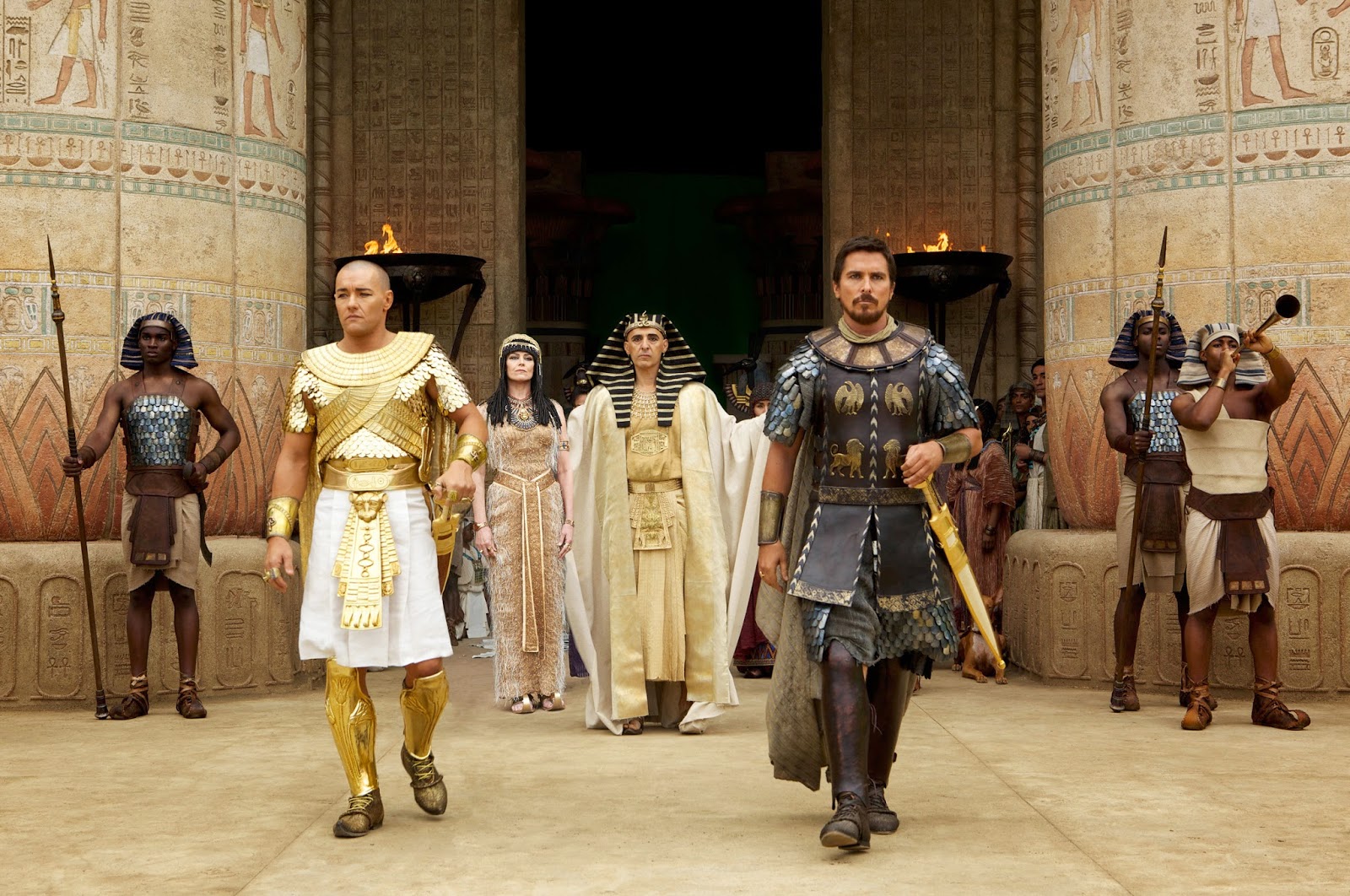
Review: Exodus: Gods and Kings


I WENT to see Riddley Scott's latest epic film on Christmas Day with my family and I was not disappointed. Scott's interpretation of the classic-biblical story takes some unexpected turns and keeps you enthralled to the very end.

Having made Gladiator, I was sure Ridley Scott would produce an epic picture worth watching, but I was disappointed with the quality of the 3D version of the film, which was the only one available at Ster Kinekor, Richards Bay.

After getting used to the first 20 minutes of the movie squinting over the war scene by the beginning of the film -which was compounded by the troops looking like ants on a stereoscopic table- I finally acclimated to eye pain.

The movie is based on the story depicted in the book of Exodus in the Christian book; The Holy Bible. While many are familiar with the story from the book itself, many know the story from the Disney Classic: Prince of Egypt.

Instead of starting with the story of Moses' (Christian Bale) birth at a time when his life was in danger of being ended by the Egyptians, as the overlords of the enslaved Hebrews, the film focuses much attention on Moses and Ramses (Joel Edgerton) as brothers.

Having a brother myself, the film resonates with me quite a lot and I was delighted to see Scott's tribute to his brother, Tony during the end credits (yup, I read those). Their brotherhood is tested throughout the film in a fresh new look at the original Exodus story.

I'm also glad they didn't get Morgan Freeman to play God in the movie (SPOILER alert ahead). Instead, they got an 11-year-old boy (Isaac Andrews) screaming dramatically with his tiny voice at Moses when God justifies his punishing the Egyptians with the seven plagues.

There is one scene (spoiler) with Nile crocodiles first on the plague agenda killing so many people in the river Nile so viciously that it stains the water red with blood for days. I found the scene incredibly gruesome but in tasteful way suited for the whole film.

Now, I am no movie guru but found the film to be beautifully done with as little CGI as possible, impeccable acting, a fresh look at an otherwise washed out biblical story, I think the film was seriously awesome in scale and Egyptological authenticity.

Overall, I like it.

Have you seen it? Tell me what you think by commenting on this blog post or pestering me on my Facebook or my Twitter accounts.


Thursday, October 23, 2014

“No pressure,” my beep

Schools opened in early January this year but messages of support are only flooding in now on radio and print, and we seem to be only concentrating on grade 12 pupils, at what seems to be the eleventh hour. What does this say to us and what effect does it have on the pupils themselves?

I was a matric student in grade 12 and for the most of us, there is nothing more difficult. We used to be told that grade 11 was the toughest grade and this resulted in the grade being called matric 1 and grade 12 downgraded to matric 2.0. One does not understand the 'truth' behind the statement until one is overcome by the fear of receiving one's report card on D-day only to wait six hours and remain the last class in the whole school to get their results and fail..

Yup, I failed grade 11 with a mathematics mark of a staggering 18% but instead of being sent back to matric 1, I got parole in the form of "condoned" (the grey area between "pass" and "fail" and the epitome of the standard of education in South Africa). Anyway, I got away with murder and "snuck into" matric 2 on the basis that I was disadvantaged by the teachers strike of 2007 that lasted six weeks.

I seriously sucked at math and no amount of last minute catch-up programme would have likely saved my ass. Over the years, I have noticed how the focus of matric 2 has intensified and wondered if this is a good thing. First of all, I found that the standard of grade 12 has "changed", and not for the good, I think.

While I was terrible at math, I was not so bad at science and I usually enjoyed going retro on the science books I read. I noticed during one visit at the local library that the biology (life sciences) textbook prescribed for grade 12 had the about the same content as an older (by give-or-take 5 years?) prescribed for grade 10!

If you go look at the books for other subjects you will also notice this trend. It seems that in an effort to increase the "pass rate" in grade 12, the government has not only turned "30%" to a pass but they have made things "easier" for matrics. That sounds like a conspiracy theory, I know, but if I am somehow "neutralised" in the near future, please lookout for chalk marks and leather-jacket residue at the scene of the crime, #justSaying.

What I have noticed in my township are the highschools’ obsessive attempts at getting 100% pass-rates. My problem is that extra classes are now being conducted all of a sudden where pupils are made to attend "extra classes" on top of the two extra hours added to the school day. These extra classes suddenly spur just a few weeks before the final exams.

Are highschool principals suddenly shocked by the advent of The Final Exams, jolting them into rapid action to "catch-up"? Why are we having Saturday classes only now as opposed to the eight months of school? Did we not know the exams were coming?

Being a part-time tutor for highschools students, I am very familiar with the frustration of grade 12 students scrambling for revisions and a plethora of "extra classes" they are being forced to attend. In my own experience, many teachers are lazy to keep up with the (now reduced) science and math syllabi and these extra classes seem to be eleventh hour efforts at covering for this.

The pupils are the victims, right? No, some are just as lazy (I've been a super lazy scholar myself, so I know). I have noticed how some pupils have questions that should have been answered by teachers, questions that leave me asking "what have they been teaching you the whole year?" and "what have you been doing in class while the teacher was teaching you?".


It looks all -doom-and-gloom right now and I am yapping about a problem I have not put forward a solution to try fix. Right now, I do not know, perhaps the reader may have a few pointers. Right now, I really hate seeing my sister having to make arrangements to find accommodation by her school because they decided the grade 12 learners need to have extra classes from 4pm to 7pm just two weeks before the beginning of the final exams.

Thursday, October 16, 2014

Yes, but no one was around during the big bang!

No-one was around during the big bang, no-one has ever seen a star’s lifecycle from birth to clataclysmic death, and we can’t put these things in the lab to test them, so where do scientists get the audacity to claim that these things happened and are happening?

A few weeks ago, I wrote a column in the Zululand Fever where I put the discipline of science within the confines of testability. I said that when one makes a claim on how nature works, then we can test it and prove it wrong or right and I claimed that anything outside this “testability” perimeter is therefore “unscientific” and “supernatural”.

A friend of mine then asked me about the Big Bang theory and how it is accepted as the origin of the universe, being an event that occurred only once, if it indeed did occur. He said, “We can’t conduct an experiment in the lab where we see the big bang again.” He also listed other things rendered “unscientific” by my testability assertion, such as multiverses and black holes (those massive stars that are so hefty that not even light can escape their gravity).

xkcd
Well, the universe acts in mysterious ways but we can find generalisations from observing how it works, like noticing how objects fall the same way every time you drop them. Scientists then formulate mathematical explanations that need to satisfy these generalisations and once they are up to par, we test them on nature. And if they pass these tests, we call them "laws of nature".

Now, each of these remains "true" until a more efficient explanation comes along. In other words, we use Ockham's razor, i.e. we cut the rubbish.

Edwin Hubble in 1929 observed that galaxies seem to be moving away from each other, as if the space between them were expanding. This changed the static view of the universe accepted at the time. Around the same time, Georges Lemaitre theorised that if the universe is expanding then it means if you extrapolate backwards it must have existed in one point in space, thus the big bang theory was born (though it was not called that at the time).

It became popular among the scientific fraternity because it was the simplest explanation for the origins of an expanding universe amidst other explanations that were much less elegant.

But we still needed to ‘prove’ the theory by finding evidence for it in nature. Obviously we couldn't use the same physical phenomenon that gave birth to it to prove it so we turned to mathematics and the mathematical results resulted testable (observable) physical phenomena.

One of these was the cosmic microwave background (CMB) which heralded indirect evidence for the big bang as it was found completely independently in 1964. At the moment there are scientists looking to disprove the big bang theory by finding phenomenon not predicted by or against the theory and until that happens, we accept it as the origin of the universe, and all major theories go through this baptism of fire all the time.

“But we can't test it in the lab,” he said. Well, astrophysicists almost never get to touch or experiment on their specimens, but they can construct good enough theories to explain phenomena from little more than star shine and use those to predict other phenomena which
when found to be true are then accepted as true until Ockham comes in.

What of multiverses and black holes? Well, the idea of multi-verses theorises that there are other universes existing outside of ours and this crazy idea came from the observation that some subatomic particles (which operate on a completely different set of laws called Quantum Theory) can exist in two places at once and even disappear here and appear somewhere else.

At the moment, the idea of multiple universes in existence are the best explanation for this and other funny behaviour and it has given birth the mathematical model of the universe called String Theory (or M-theory) which is yet to be proven but is our best bet that can be tested as we get better sophisticated scientific instrumentation.

As for black holes, they were predicted by Albert Einstein in his theory of General Relativity and later found in nature through the powerful gravity they exert on other stars, the x-ray radiation emitted when they devour hapless stars and plumes of gas in space.


Sometimes you just have to observe and deduce and test those deductions by observing somewhere else in nature.

Tuesday, September 30, 2014

Jesus heals today!

A response to my column from last week


Attention:
Sibusiso Biyela

Perhaps Sibusiso, you need to be where God is at work by His Holy Spirit.

I have seen people delivered from drugs, alcohol & cigarettes. When they realize how much God loves them & what Jesus has done for them. I saw an old lady throw away the hearing aids when she could hear!  Backs, knees & shoulders healed. Warts fall off & dr's confirm that lumps/growths have disappeared.


I have been healed of migraines for 20 years & received other healings too.

Scientists are often proven to be wrong as time passes. Some scientists & unbelievers have become believers in Jesus, whilst trying to prove the Bible to be wrong! Josh Mcdowell, Carl Baugh, dr Grady McMurty, Bruce Malone.. 

No one has evidence that humans 'evolved' from apes. If we had, why are there still apes today? From a pig's tooth they drew Nebraska man?!?


 The Bible mentions Dinosaur/Leviathan eleven times. So besides their skeletons deposited during the Flood, there are shell fossils up in the mountains to prove The Bible is true!

My husband had a bleeding ulcer some years ago when we were on holiday @ Ficksburg.

As he had vomited blood & passed a malaena stool I told him that he will live & not die & declare the works of The Lord! Psalm 118:17

With the authority of Jesus Christ & in His name i commanded the bleeding to stop! Friends prayed with him & we got medication for him. He would not go
to   hospital, so i drove him home the following day. 

He refused to have blood transfusions then, but had 3 pints & an iron infusion 3 weeks later. Tests could not reveal where the blood loss had occurred! The ulcer healed & no scar! 

Signs,wonders & miracles are still occurring today!

We are believers empowered by The Holy Spirit with gifts of healing.
1Corinthians 12:9 We are not Faith Healers.

 By Grace we are saved through faith; & that not of yourselves: it is the gift of God :9 not of works, lest any man should boast. 

See Andrew Wommack healing journeys. People healed of cancer, injuries, medical conditions & a dead baby raised! Joseph Prince, Bill Johnson, Joshua Mills, Patricia King,Cindy Trimm, Alliss Creswell, Joan Hunter & countless others see miracles in their ministry.

 The government in Mozambique declared that the area where Heidi Baker has her ministry is a Malaria-free zone!

 Sid Roth interviews with people on dstv/Google are amazing! Nick Griemsman
delivered from Schizophrenia & John Waller from Bi-polar.  

 If testimonies to God's goodness were printed in your paper you would receive hundreds/thousands locally! To God be the glory!

 1 John 3:23 And this is His commandment, That we should believe on the Name of His Son Jesus Christ, & love one another, as He gave us commandment. 

Meribah


PS. Where healing has not manifested, Cayenne Pepper  excellent for heart & gastric ulcers. Daily lemon juice for ulcers too. 

Friday, September 26, 2014

Where logic and reason fail

I am a self-proclaimed advocate of science, but I have learnt over the years that mine is a stupid venture. Science is a body of knowledge that is applied by people we call scientists to understand the physical world using experimentation and reasoning to come to conclusions.

It is very important that advocates of science such as myself drive in their own lanes and realise that science cannot solve, know, or understand everything. This is a very humbling fact, one that needs to be accepted as is, on account of the existence of opinions and the growing tendency to let logic and reason take a backseat in a world ruled by counter-knowledge.

Now, I have been told, and have subsequently read many a literature on the internet, telling me that there are some things that science cannot know and can never explain. That statement can seem very flat-worldly, but such an analysis would be unfair to the advocate of the supernatural who feels his opinion matters as much as any.

Fair enough but how can we differentiate between established facts and counter-knowledge? Well, the western world has come up with a few useful tools for the physical world: experimentation and Ockham’s razor sums up most of these tools. When researchers are faced with a natural phenomenon that is not yet understood, they use experimentation to determine the mechanism driving the phenomenon.

Where experimentation fails or is not possible (such as a historical event), it is useful to ‘cut the crap’. This is where Ockham’s razor comes in; it looks at the many explanations presented and cutting the bullshit, settles for the simplest one.

In other words, where there is a perfectly natural explanation for a phenomenon, the supernatural is frowned upon –that is until testable and reliable evidence supports it.

It is important that the most established theories of nature encounter the most rigorous and revealing episodes of scientists trying to prove it wrong, and the most accepted are only so as they withstand the plethora of attempts to disprove them. Such is for the physical world, though, whilst the supernatural has a different set of rules outside the realms of science.

And out there, pretty much anything goes. This reminds me of an old slogan of The Church of Scientology; if it’s a fact for you, it’s a fact. Let us consider a man of God who claims that the Holy Spirit resides within him. This is a 'fact' that cannot be tested, and therefore resides outside science.

If, however, the ambitious man of God claims that he can use the Holy Spirit to heal the injured, cure AIDS and cancer through prayer, he then brings aspects of the supernatural world to our physical reality, and at this point allows scientific testing of these claims. No occurrence of faith healing being proven to work has been reliably recorded.

A more physically viable explanation would be that he who claims to be healed by a faith healer through nothing more than prayer is telling an untruth. Whilst this may break the credibility of the witness, it keeps intact the laws of physics by cutting the crap, in other words, we use Ockham’s razor.

Whilst this fact means faith healing does not work in the physical world, it says nothing of the supernatural, which as I said earlier, anything goes. This place where anything goes is called by Collin Campbell as the cultic milieu; which is the cesspool of all that is unbelievable and where those that forgo reason, logic and choose to ignore all manner of established evidence, reside.

I have been told also, that miracles cannot be explained by science because they operate outside the laws of physics. This is a face-palm-worthy statement at face value, but then I remember how science cannot explain “everything.”

When it comes to so-called miracles and the hocus pocus that plagues the cultic milieu, the phenomena of this supernatural world are only as strong as those who believe in it, the advocates. And this is where science (which encapsulates logic and reason), differs: it works whether you believe in it or not.

So, what do you believe in?   

Sunday, June 8, 2014

Bad apologetics

(The incorrect use of science and faith to defend atheism/theism that seems to strengthen each's arguments but instead greatly undermines it. )

I thought I should write on some of the Earth-shattering and very heated (as heated as text can get) conversations on Facebook I sometimes find myself engaged in.

Many of these conversations usually start with an atheist or theist (usually a Christian) making bold claims in defense of their belief. Ideally, I prefer to not get involved with them. Ideally.

The issue arises when an apologetic uses (either on purpose or blatantly) unsupported claims to attack the other belief or defend one's own. In many a debates between Christians and atheists, I find myself hopping between the two parties when I find that the side I have chosen uses bad apologetics.

One Facebook encounter occurred a few hours before I started writing this column and this friend of mine is a self-proclaimed atheist whom I met during a science communication competition in Grahamstown. Now, he shared a status updated by a friend of his:

The reality is, Jesus was a mythical figure. It was the political establishment that sought to historize the Jesus figure for social control…. thus began a long history of Christian bloodshed and spiritual fraud.
And for the next 1600 years, the Vatican maintained a political stranglehold on all of Europe, leading to such joyous periods as the
Dark Ages, along with enlightening events such as the Crusades, and the Inquisition….Christianity, along with all other theistic belief systems, is the fraud of the age.

This statement is riddled with misinformation which should render the argument against Christianity devoid of any true substance. There are many flaws here but I will mention a few.

The most obvious flaw is the utterance that Jesus Christ was a "mythical figure". While one cannot divulge on the divinity of the Christ, his existence is almost a certainty as far as the Bible's historical integrity is concerned.

The Dark Ages (formally Middle Ages) are marked by the collapse of the Roman Empire in the 4th century and considered "dark" by historians due to the decline of historical records from the period, and not so much Christian violence as the statement may suggest.

Petrarch, an Italian scholar and historian who coined the term "dark ages" saw the post-Roman centuries as "dark" compared to the light of the Age of Classical Antiquity. He also considered the Age he lived dark from the "lack of cultural achievements" as compared to the previous age.

Now, Protestants of the 16th and 17th centuries considered the Middle Ages as a period of Catholic (not Christian) corruption. Like Petrarch, who did not attack Christianity per se, the protestants were seeking a restoration of biblical Christianity. [Emphasis mine].

British historian, Gilbert Burnet, at the last quarter of the 17th century in one of his earliest works: The Epistle of Dedicatory to Volume I of The History of Reformation of the Church of England said,

The design of the reformation [the Protestant movement] was to restore Christianity to what it was at first, and to purge it of those corruptions, with which it was overrun in the later and darker ages.

The purported evidence of the violent nature of Christianity ( sometimes considered a vehicle of many wars) is in many ways flawed as the mentioned periods of conflict are not in fact attributed to the ideals of Christianity but are the result of some individuals in authority who saw Christianity as a means to dominate and rule the masses.

My stating these facts is not to discredit atheism or support Christianity, but to try to do away with the use of unsupported assumptions and unchecked information to push forward a belief in an attempt to defend as this has the effect of working against the apologetic in the case that he is debating with people who are less inclined to ignorance (and happen to own a smartphone).

Atheists and theists alike should refrain from making arguments and stating facts from the top of their heads and using information they have not checked themselves, to defend their beliefs.

Also of great importance is the personal slander and insults thrown by either side when the facts run out. I say let the facts speak for themselves and defend your belief by doing a little Googling and actually reading the bible before attacking or defending Christianity.

Archbishop Emeritus Desmond Tutu once said, "Don't raise your voice. Improve your argument." Let us check our facts, people.